Friday, November 21, 2014

On the Menu

Senate Bean Soup

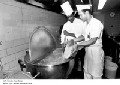
Senate restaurant staff preparing bean soup
Bean soup is on the menu in the Senate's restaurant every day. There are several stories about the origin of that mandate, but none has been corroborated.  
According to one story, the Senate’s bean soup tradition began early in the 20th-century at the request of Senator Fred Dubois of Idaho.  Another story attributes the request to Senator Knute Nelson of Minnesota, who expressed his fondness for the soup in 1903.
The recipe attributed to Dubois includes mashed potatoes and makes a 5-gallon batch.  The recipe served in the Senate today does not include mashed potatoes, but does include a braised onion.  Both Senate recipes are below.
The Famous Senate Restaurant Bean Soup Recipe
2 pounds dried navy beans
four quarts hot water
1 1/2 pounds smoked ham hocks
1 onion, chopped
2 tablespoons butter
salt and pepper to taste
Wash the navy beans and run hot water through them until they are slightly whitened. Place beans into pot with hot water. Add ham hocks and simmer approximately three hours in a covered pot, stirring occasionally. Remove ham hocks and set aside to cool. Dice meat and return to soup. Lightly brown the onion in butter. Add to soup. Before serving, bring to a boil and season with salt and pepper. Serves 8.
Bean Soup Recipe (for five gallons)
3 pounds dried navy beans
2 pounds of ham and a ham bone
1 quart mashed potatoes
5 onions, chopped
2 stalks of celery, chopped
four cloves garlic, chopped
half a bunch of parsley, chopped
Clean the beans, then cook them dry.  Add ham, bone and water and bring to a boil.  Add potatoes and mix thoroughly.  Add chopped vegetables and bring to a boil.  Simmer for one hour before serving.

Thursday, November 20, 2014

VPN

     There are probably hundreds of thousands of pizza joints scattered over the globe.  And some are no doubt better than others, offering an endless variety of styles and toppings on all different thicknesses of crust.  Some are very good, and others...well, not so much.

     So how do you know that the pizza you ordered will be memorable in a positive way?  There is no absolute guarantee, but there is one indication that the pizza on your plate is the real deal.  Look for the letters "VPN" to be displayed in the establishment.  The logo might appear on the front door, by the cash register or on the menu.


   VPN stands for Associazione Verace (or sometimes Vera) Pizza Napoletana.  Recognized by the Italian government denomination of control (DOC) it is an organization that was instituted in Naples in 1984 "to promote and protect the true Neapolitan pizza."  Along with companion organizations, VPN Americas in the US and Canada and VPN Giappone in Japan, they monitor strict requirements that respect the tradition of the art of Neapolitan pizza making.

     Those requirements include the following:

1. Use of a wood burning oven that can heat to 800 degrees F.

2. Use of only fresh, all natural, non-processed ingredients like "00" flour, San Marzano tomatoes, Fior-di-latte or Bufala mozzarella, fresh basil, salt and yeast.

3. The must be kneaded either by hand or with a low-speed mixer.  No mechanical dough shaping is permitted.  The pizza baking time is not to exceed 90 seconds.

4. The facility must have a proper work surface, preferable a marble slab table.

5. The size of the pizza cannot be larger than 14 inches and must have a raised edge crust and a thin (0.11") center.  The slice should be soft and elastic and easily foldable, not hard or brittle.

Upon inspection, if these criteria are met the ownership can apply for membership and submit a $2,000 certification fee and then pay $250 annual dues to maintain their status.

When I perused the menu at Punch I took notice that the V.P.N. logo appeared in the lower left corner above the words, "Punch is one of a few pizzerias outside Naples, Italy to be a member of Vera Pizza Napoletana, an organization dedicated to regulating the authenticity of Neapolitan pizza."

So the next time you're hungry for a pizza, be sure you get the real deal!  Make it a VPN.


Wednesday, November 19, 2014

Taking a Punch

     Perhaps there is no better place to experience true Minnesota pizza bliss than at Punch in St. Paul.  Their menu offerings have been described as Michael Jordan playing in the 6th grade basketball finals.  There's no competition!  The owner, John Sorrano, grew up in Milan and learned first hand from local pizzaiolis how to craft an authentic Italian Neapolitan pizza. He was able to translate that experience when he opened his first restaurant in the Twin Cities.


   So I had to try one of the best and visited there last August.  They are a certified VPN restaurant (more about that in a subsequent VinnyPost) and the first thing I noticed was their huge wood burning oven that dominated the space.  It heats up to a blistering 800 degrees F and cooks a pizza in 90 seconds.  Using only fresh ingredients the menu lists 17 classic style pies with names like Napoli, Borgata and Vesuvio.  For those who like their pizza sans tomatoes there are 5 blanco pies to choose from.  And if none of those nearly two dozen possibilities are to your liking you can craft your own with a mind dizzying 28 different toppings.  The combinations are endless!!!  So I combined sausage, arugula and feta on my personal pie and in less than 2 minutes it was ready and I carried it to my family style table.  Magnifico!  The ingredients were all fresh and enhanced by the tangy sweet tomato sauce and the secret recipe dough that was soft and pliable, not burnt and stiff.  Punch is definitely in a league of its own.

     But just on the outside chance that I wasn't satisfied with my meal there was a line at the bottom of the menu that read:


SECOND CHANCE FOR PIZZA ROMANCE?
Don't like your pizza?  Tell us - no matter how busy we are!
Come up to the pick-up counter and we'll remake it in 90 seconds.

Now that's customer satisfaction!


Tuesday, November 18, 2014

Pizza Geography

     Naples, Italy is the undisputed birthplace of pizza.  It was there that local pizzaiolis began topping dough with tomatoes and cheese and hand firing it.  Gennaro Lombardi is credited with creating the first New York style thin crust pie in his grocery store on Spring Street in the Big Apple in 1905.  Rudy Malnati first baked a deep dish pizza in Chicago in the early 1940s.  And in 1979 Rose Totino ushered in the age of frozen pizza when she and her family teamed up with the folks at Pillsbury to patent the dough for it in Minnesota.

     Minnesota?  A pizza mecca?  We are all familiar with both the New York and Chicago style of pizza.  But is there a Minnesota style?  Apparently so.  It has been described as having a thin crust and it is cut in squares, not pie cut.  And as an August '14 article in Mpls.St.Paul Magazine states, "You really need to be from here to understand it."


     There just may be a Minnesota style pizza and the Twin Cities probably should be considered as a pizza lovers destination.  Move over Big Apple and Windy City and make room at the table for another contender for the best pie in America.

     The article, aptly titled, "PIZZA! PIZZA! PIZZA!" described no less than 3 dozen locales within the MSP metro area that are producing world class (and unique) pies.  Take for example Carbone's Pizza, called by some a Minnstitution with 32 locations in the state.  They define the category with a thin crust, sweet and tangy sauce and a mantle of cheese.  Broadway Pizza includes sauerkraut and two kinds of bacon (regular and Canadian) on one of their offerings.  Fireside has a Pepper Special that is topped with pickled banana peppers, green and red bell peppers and pepperoni, while Leaning Tower Pizza has a Hot Tower special that tantalizes the tongue with a hot and spicy sauce, crushed red pepper, pepperoni, jalapenos and pepper jack cheese.  Perhaps the most unique pie is produced at Pizzeria Lola where the Sunnyside Pizza is topped with 2 eggs sunny-side up and was featured on Guy Fieri's "Diners, Drive-Ins, and Dives."  And for a local Scandinavian twist, Pig Ate My Pizza serves up a pie with smoked salmon gravlax and fried capers, salt and vinegar potato chips and spicy nasturtium flowers.

So of course when I was visiting in the Twin Cities last summer I had to see (and taste) for myself the local take on the quintessential American Pie.  More on that tomorrow.

Monday, November 17, 2014

Italian Cousins

     Italy is home to some wonderful food.  Probably one of the first things that comes to mind when you think Italian cuisine is the pizza.  Two close cousins to that marvelous pie are the Calzone and the Stromboli.


     Originating in Naples, the calzone has been best described as a folded pizza.  Translated as "pants leg" it is a favorite street food that can be eaten on the go.  It is made with bread dough that is coated with marinara sauce layered with browned, crumbled sausage and topped with mozzarella, then folded over into a half moon and baked in a hot oven.  It is a one person pizza conveniently made portable.


Typically the stromboli is made without sauce and has a distinctly different shape.  The bread dough is rolled out in a large rectangle, topped with cheese, meats and veggies, then rolled into a log shape before being baked in the oven.  And according to Bill Daily of the Chicago Tribune, the stromboli originated in Essington, PA just south of Philadelphia International Airport.  It was back in 1950 that Nazzareno "Nat" Romano developed the concept and made some samples for neighbors of his pizza shop.  But he couldn't come up with a suitable title for his new creation.  It was a friend, soon to become a relative, that blurted out "Stromboli!" recalling the stir that the movie of the same name starring Ingrid Bergman had caused when she and her producer had a child while both being married to someone else.  But if you prefer a more sedate explanation, Stromboli is also a volcanic island off the coast of Sicily.


Friday, November 14, 2014

Fall Classic

     Two Fall favorites combine to make a classic dessert.  Apples and pomegranates are the main ingredients in this tasty crisp.  After you harvest the arils underwater you can try out this recipe:


Brenda's Apple & Pomegranate Crisp

 
Brenda's Apple and Pomegranate Crisp Recipe

4 medium apples, cored peeled and sliced                1/2 cup rolled oats
1/2 pomegranate, skin & membrane removed         1/2 cup all purpose flour
1/2 cup brown sugar                                                      1/2 cup white sugar
1 Tbsp ground cinnamon                                              1/2 cup unsalted butter
1/2 tsp ground nutmeg

Preheat the oven to 375F.  Butter a 9x12" baking dish.

In a large bowl, toss together the apples, pomegranate seeds, brown sugar, cinnamon, and nutmeg.  Spread evenly into the prepared pan.  In the same bowl, stir together the oats, flour and sugar.  Rub in the butter between your fingers until the mixture resembles coarse crumbs.  Sprinkle over the top of the fruit.

Bake for 45 minutes in the preheated oven, or until the apples are soft.  Let stand 10 minutes before serving.  Serve warm or at room temperature.

Recipe courtesy of Allrecipes.com

Thursday, November 13, 2014

Accessing the Arils

     Most of us just call them seeds.  But the tiny ruby orbs inside the pomegranate are actually called arils.  The Huffington Post rightly states that "...the pomegranate is one of the trickiest, yet tastiest fruits...they bear marvelously sweet arils."

     But getting the Jewel of Autumn to release those tiny arils is another story entirely.


     Several theories predominate in culinary wisdom, from whacking the halved fruit with a large wooden spoon, to spanking it with a spatula or mallet.  One source I consulted recommends rolling the fruit first as you would a lemon or lime.  Then there's another method that I have nicknamed the Magellan Mapping approach that advocates a primary circumnavigation of the pomegranate before scoring it from pole to pole into quarter sections.

     But most seasoned pomegranate de-seeders employ what I call the Jacques Cousteau method, that is, underwater.  It goes like this:

1. Cut the crown (protruding blossom end) off the pomegranate, removing with it some of the pale-yellow pith.  Take care not to pierce the seeds within.

2. Lightly score the skin in quarters from stem to crown end.

3. Immerse the scored fruit in a large bowl of cool water and soak for 5 minutes.  Holding the fruit under water, break sections apart with your fingers, separating the seeds from membrane.  The seeds will sink to the bottom of the bowl.

4. Discard skin and membrane.  Drain the seeds and dry on paper towels.

     But before you attempt the following, one word of caution.  Pomegranate juice stains!  It will leave red stains on both hands and apparel.  So as the saying goes, "Wear old clothes."  And goggles and snorkel are optional.