Tuesday, May 22, 2012
Research
For the sake of culinary research I will not be able to issue any VinnyPosts until June. So stand by for reports of my findings. They will be prolific!


Monday, May 21, 2012
Now That Takes the Cake
It was late September of 1967 and Hainer Hall, the freshman men's dorm at Eastern Baptist College was bursting at the seams with incoming students. Two of the young men matriculating there were from nearby high schools, but they had never previously met. Both were just 18 years old but Bob had already been baking and decorating cakes for 2 years. They soon became close friends, joining the same fraternity and being elected to class offices.

Different career paths emerged for them: education and social work but upon graduation they shared an apartment in Conshohocken with another classmate. As time went on they followed their career track and cake baking and decorating was still Bob's favored avocation even baking the wedding cake for a very warm evening wedding in July 1975.


And this week there will be another culinary pursuit as the two fraternity brothers explore the Crescent City. Doesn't that take the cake?


Over the years the friendship grew and their culinary pursuits took them literally all over the world: India, Italy, Japan, France, Korea and Australia just to name a few. And just last weekend they traveled together to deliver another wedding cake and also to celebrate a new accomplishment: cake sculpturing. It was a special groom's cake of Taz, the Tasmanian Devil.


Friday, May 18, 2012
What's that in your hat?
 As you may recall, earlier in the week I had more leeks than I knew what to do with. So with some creativity I made soup with the Allium porrum that I had on hand. Leeks are related to the onion, both being members of the lily family. But unlike onions leeks do not have a bulb on the root end and are more refined and subtle with a sweet flavor. They are native to the Mediterranean region and have been cultivated for over 3,000 years. They are even mentioned in the Bible, in the book of Numbers, as a food missed by the Children of Israel when they left Egypt. Leeks have been a popular staple in Europe, even though their name in French is poireau which translates "simpleton." Due to their flavor they have often been referred to as "poor man's asparagus."
But did you know that the leek is the official emblem of Wales? It dates back to the 7th Century when King Cadwaladr of Gwynedd instructed his warriors to place a leek on their helmets to distinguish them from the Saxon enemy they faced in a battle that took place in a leek field. That victory continues to be celebrated each year on St. David's Day, March 1st. The event is also referenced by Shakespeare in his play, Henry V when Henry, wearing a leek in his hat proclaims, "...for I am Welsh, you know, good countryman."
Leeks are a good dietary provider of folic acid for good circulation, calcium for strong bones, potassium to strengthen the heart, and Vitamin C for tissue growth and repair. Leeks are also known to be effective anti arthritic agents. To learn more about growing leeks, click on the highlighted University of Minnesota site.
Check out this website for some interesting uses for leeks in cooking.
Thursday, May 17, 2012
The Vicissitudes of Life
This week I discovered that it is impossible to purchase just one leek. Like every other consumer item, leeks are sold in bulk. I only needed one for a recipe, but it was impossible to get just one. They were sold in triplets. So reluctantly I made the purchase and then had 2 more than I needed and had them chilling in the refrigerator until I could figure out what to do with them.
I also noticed that the parsley in my porch herb pot was growing prolifically, out of control, in addition to having a left over ham quarter and some Yukon gold spuds about to sprout eyes. So what to do with these disparate elements? What else, make soup!
I didn't need a recipe, it was a no-brainer to cook up a tantalizing and healthy soup with the ingredients at hand. First I sauteed the leeks in butter after a thorough rinsing to remove any sand or grit, then I added some vegetable stock and threw in the diced potatoes and allowed the mix to simmer for 15 minutes. While that was on the stove I cubed the ham and assembled my food processor. When the timer sounded I removed half of the potato leek mix into the processor and pureed it as I added the ham to the pot, along with a dash of marjoram and a teaspoon full of thyme. The puree was then added back into the soup along with some chopped parsley and the soup was ready to cool. Later in the day I delivered it to my uncle for a week's worth of lunches.
To paraphrase "When life hands you lemons, make lemonade" I would posit "When life hands you leeks, make soup!"
I also noticed that the parsley in my porch herb pot was growing prolifically, out of control, in addition to having a left over ham quarter and some Yukon gold spuds about to sprout eyes. So what to do with these disparate elements? What else, make soup!
I didn't need a recipe, it was a no-brainer to cook up a tantalizing and healthy soup with the ingredients at hand. First I sauteed the leeks in butter after a thorough rinsing to remove any sand or grit, then I added some vegetable stock and threw in the diced potatoes and allowed the mix to simmer for 15 minutes. While that was on the stove I cubed the ham and assembled my food processor. When the timer sounded I removed half of the potato leek mix into the processor and pureed it as I added the ham to the pot, along with a dash of marjoram and a teaspoon full of thyme. The puree was then added back into the soup along with some chopped parsley and the soup was ready to cool. Later in the day I delivered it to my uncle for a week's worth of lunches.
To paraphrase "When life hands you lemons, make lemonade" I would posit "When life hands you leeks, make soup!"
Wednesday, May 16, 2012
The King of Herbs
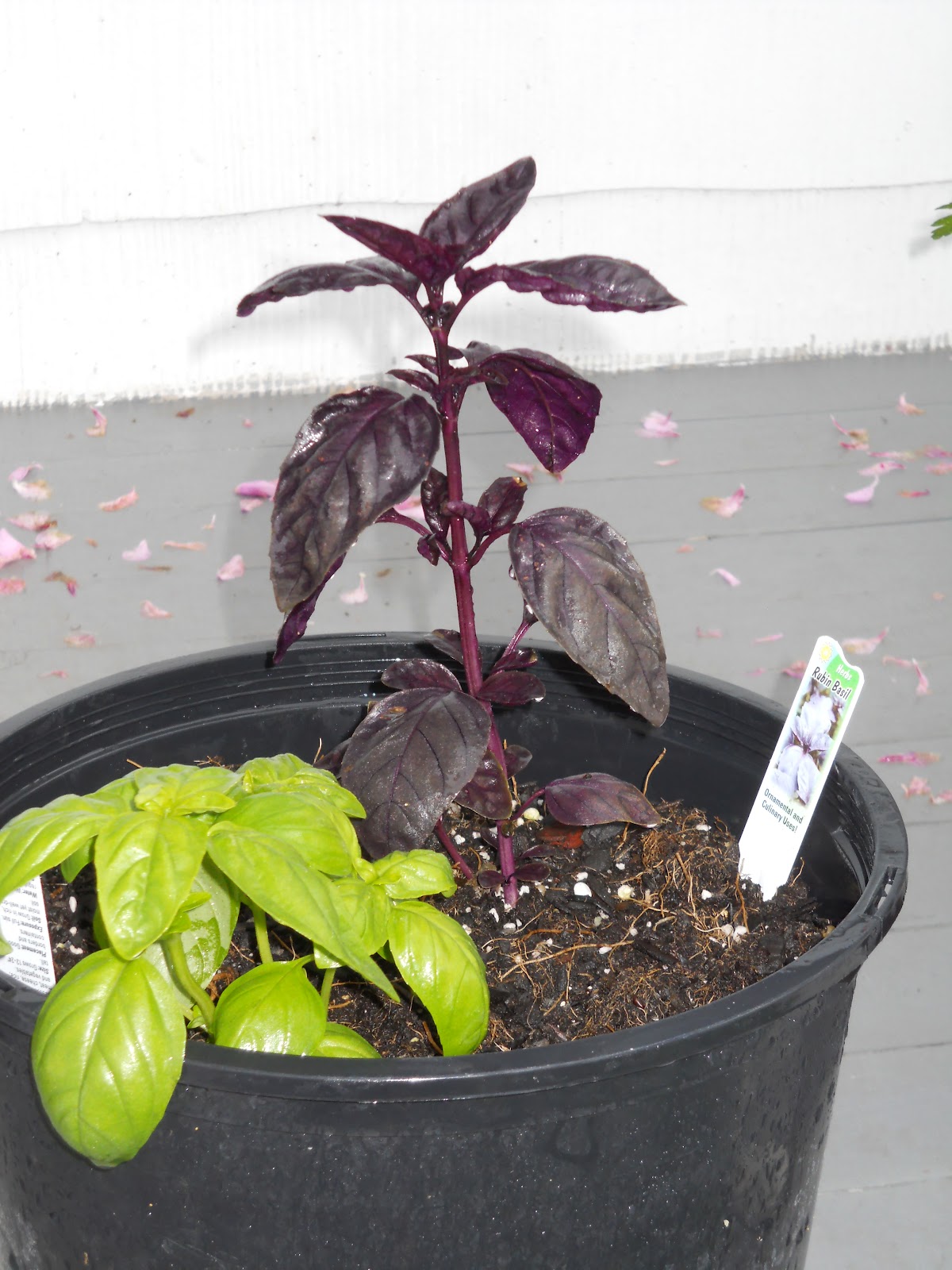
Last Friday I received two basil plants to complete my herb collection growing in porch pots. Surprisingly, one was purple, a color of the herb I had never encountered before. I quickly discovered that it was one of the more than a dozen varieties of the King of Herbs and is a Red Rubin. So I did a little more investigation and found out quite a bit about this most well known of herbs grown on our planet.
 Basil has been around for thousands of years. It originated in the Middle East and Asia and is also known as St. Joseph's Wort. It is a low growing plant with tender but large leaves and a member of the mint family. The name comes to us from the Greek language and is translated as king. It truly is the king of herbs and is often associated with religion and folklore. It has been described as a holy herb, especially in the Greek Orthodox Church where it is kept potted near the altar to provide religious healing and is used in the preparation of holy water. In India it was used in courts of law where citizens would swear their oath upon it. In Italy it symbolized love and was worn as an adornment in the hair, hoping to attract a true love. For that reason it was also carried in the pockets of Mexicans.
Basil prefers to grow in warm weather with lots of sun and some varieties can reach a height of 3 feet. It matures in 85 days and produces a brilliant white blossom which is also edible. Some of the varieties have the name of the flavor they impart, like cinnamon, lemon, anise and sweet. Beside the familiar green basil there are different colored plants with names like Red Rubin, Dark Opal, Osmin, Purple Thai and Asian. While the majority of basil plants are grown for their use in cooking, some are strictly ornamental and other are cultivated for their medicinal value.
Basil is a mildly sedative herb that lowers fever, relaxes spasms, improves digestion, combats colds and flu, counteracts migraines and insomnia, anxiety and exhaustion. It is also a preventative aid against parasites and bacteria. Of the essential oils contained in basil, one of the most important is eugenol which reduces inflammation within the body. It contains high levels of beta-carotene, Vitamin A and lutein which are all valuable antioxidants and reduce the effects of aging.
And you thought it was only good as a flavoring for tomato sauce!

Basil prefers to grow in warm weather with lots of sun and some varieties can reach a height of 3 feet. It matures in 85 days and produces a brilliant white blossom which is also edible. Some of the varieties have the name of the flavor they impart, like cinnamon, lemon, anise and sweet. Beside the familiar green basil there are different colored plants with names like Red Rubin, Dark Opal, Osmin, Purple Thai and Asian. While the majority of basil plants are grown for their use in cooking, some are strictly ornamental and other are cultivated for their medicinal value.
Basil is a mildly sedative herb that lowers fever, relaxes spasms, improves digestion, combats colds and flu, counteracts migraines and insomnia, anxiety and exhaustion. It is also a preventative aid against parasites and bacteria. Of the essential oils contained in basil, one of the most important is eugenol which reduces inflammation within the body. It contains high levels of beta-carotene, Vitamin A and lutein which are all valuable antioxidants and reduce the effects of aging.
And you thought it was only good as a flavoring for tomato sauce!
Tuesday, May 15, 2012
In Penn's Woods
On Monday I had the somber duty to perform a funeral service for the father of a long time friend from North Wales. We alternately laughed and cried as we recalled a life well lived. Then after the interment where four generations of my own kin are laid to rest we gathered for lunch at a venerable local landmark, The William Penn Inn. The family had only contacted them on Friday afternoon and amazingly the management provided our group with a sumptuous buffet luncheon. On one side of the room there before us was a fresh fruit and salad table and across the room was another table of entrees and sides that could satisfy any palate. We could choose from glazed salmon, capon and pork loin and the accompanying rice pilaf, creamy mashed potatoes, green beans and cauliflower gratin. And on the tables were warm, fresh baked dinner rolls with compound butter. And for dessert a strawberry sundae with flecks of real vanilla bean in the ice cream. It was a meal rivaled only by the conviviality of the guests who gathered in memory and in gratitude for the life of Milton Schatz.

But I guess I shouldn't have been surprised by the quality of the meal or it's prompt preparation and presentation. After all, the William Penn Inn has been providing such accommodation for nearly 300 years. Penn's Woods was originally a colony founded by Quaker William Penn as a noble experiment in religious tolerance. And around 1700 Penn himself, along with his daughter, Letitia, visited the Gwynedd Friends Meeting, staying in the area for a few days before traveling on to tour his expansive land grant. A public house was established just across "The Great Road" (Sumneytown Pike) from the meeting house in 1714 that fronted "The State Road" (DeKalb Pike) to provide food and lodging for weary travelers making their way from Penn's "Greene Country Towne" to locations north and west of Philadelphia. The way station was originally deeded to the Evans family, early welsh settlers in Gwynedd. Over a century later, in 1818, the structure was sold to David Acuff and remained under that family's ownership for 3 generations. In 1827 proprietor Acuff secured a license to operate a tavern and gave his venture it's present moniker.

It was at the turn of the century in 1900 that Algernon Yothers leased the inn from the Acuff family and expanded the operation to include stables at the rear of the property that were equipped with "pure artisan well water and electric lights." He also raised the roof to add a third floor and added on a two story porch. Since that time there have been a succession of owners, each contributing their own special touch in decor, menu, and service. The William Penn Inn today is the oldest continuously operated country inn in Pennsylvania. It remains one of the foremost locations for a special event or a memorable meal. After all, they've been in the business for nearly three centuries.
photo courtesy of DJM
But I guess I shouldn't have been surprised by the quality of the meal or it's prompt preparation and presentation. After all, the William Penn Inn has been providing such accommodation for nearly 300 years. Penn's Woods was originally a colony founded by Quaker William Penn as a noble experiment in religious tolerance. And around 1700 Penn himself, along with his daughter, Letitia, visited the Gwynedd Friends Meeting, staying in the area for a few days before traveling on to tour his expansive land grant. A public house was established just across "The Great Road" (Sumneytown Pike) from the meeting house in 1714 that fronted "The State Road" (DeKalb Pike) to provide food and lodging for weary travelers making their way from Penn's "Greene Country Towne" to locations north and west of Philadelphia. The way station was originally deeded to the Evans family, early welsh settlers in Gwynedd. Over a century later, in 1818, the structure was sold to David Acuff and remained under that family's ownership for 3 generations. In 1827 proprietor Acuff secured a license to operate a tavern and gave his venture it's present moniker.

Monday, May 14, 2012
Pollo al Mottone
Of all the cuisines I enjoy cooking the flavors of Tuscany are still my favorite. There is something unpretentious and straight forward about that style of cooking that I admire. This northern portion of Italy discovered fresh and local long before it became a buzz word in high end restaurants.
So when I recently came across one of Steven Raichlen's grilling recipes for grilled chicken under a brick I immediately had to try it. I already own two of his cookbooks, Beer Can Chicken and How to Grill. This most recent recipe, however, appeared in the June/July 2012 edition of Fine Cooking magazine.
As is typical for Tuscan cooking, the instructions are very easy to follow and the ingredients are few. The premise is that applying pressure (an aluminum covered brick) on top of the chicken will keep the bone in breast moist and prevent it from drying out as white meat is prone to do. Cooking over indirect heat also cooks evenly and helps to eliminate flair ups. But before the chicken is cooked it is given a rub of fresh herbs that have been given a quick chop in a food processor. So I went to my back porch herb pot and picked some sage and rosemary and added it to some garlic cloves and peppercorns and a touch of kosher salt. The recipe calls for a drizzle of olive oil on the skin of the chicken before rubbing on the herb mixture, but I added my own touch by gently lifting the skin from the meat and spreading half of the herbs under the skin with a spash of olive oil. The result was a, moist and flavorful Tuscan chicken that had a golden brown and crisp skin and tender, juicy white meat.
Here's what the author has to say about pollo al Mottone: Although this technique is traditionally used with a spatch-cocked whole chicken, I like to use it for chicken breasts, which are notorious for drying out when exposed to the high heat of the grill. The weight of the brick presses the meat into the grill for faster, more even cooking, excellent crisping, and gorgeous grill marks. It also works as a cover for the meat, keeping it moist.
And I purposely made enough to cut up later for a Tuscan chicken salad!
So when I recently came across one of Steven Raichlen's grilling recipes for grilled chicken under a brick I immediately had to try it. I already own two of his cookbooks, Beer Can Chicken and How to Grill. This most recent recipe, however, appeared in the June/July 2012 edition of Fine Cooking magazine.
As is typical for Tuscan cooking, the instructions are very easy to follow and the ingredients are few. The premise is that applying pressure (an aluminum covered brick) on top of the chicken will keep the bone in breast moist and prevent it from drying out as white meat is prone to do. Cooking over indirect heat also cooks evenly and helps to eliminate flair ups. But before the chicken is cooked it is given a rub of fresh herbs that have been given a quick chop in a food processor. So I went to my back porch herb pot and picked some sage and rosemary and added it to some garlic cloves and peppercorns and a touch of kosher salt. The recipe calls for a drizzle of olive oil on the skin of the chicken before rubbing on the herb mixture, but I added my own touch by gently lifting the skin from the meat and spreading half of the herbs under the skin with a spash of olive oil. The result was a, moist and flavorful Tuscan chicken that had a golden brown and crisp skin and tender, juicy white meat.
Here's what the author has to say about pollo al Mottone: Although this technique is traditionally used with a spatch-cocked whole chicken, I like to use it for chicken breasts, which are notorious for drying out when exposed to the high heat of the grill. The weight of the brick presses the meat into the grill for faster, more even cooking, excellent crisping, and gorgeous grill marks. It also works as a cover for the meat, keeping it moist.
And I purposely made enough to cut up later for a Tuscan chicken salad!
Subscribe to:
Posts (Atom)