Friday, March 15, 2013

A Chicken in Every Pot

     chicken soup photo: chicken in a cup Chicken-Soup.jpg

     I dutifully saved the chicken carcass after serving up my favorite Tuscan meal Wednesday evening, Pollo Arrosto al Limone.  It would be a crime to waste all that wonderful flavor left on the bones and in the skin.  But in the past my chicken soup always tasted anemic, flat and flavorless and I couldn't understand why.  After all, I boiled the left over chicken with carrots, celery and onions and usually threw in a cup or two of wild rice after adding some sage and thyme.  But time after time it was lackluster, tasting more like dishwater than soup.

    
     Thinking about it I realized my failure was that I did not spend adequate time building layers of flavor.  I just put all the ingredients in the pot and boiled it for about 3 hours, until there was absolutely no flavor left: not in the chicken, not in the carrots, and certainly not in the swollen and soggy rice.

     So this morning I took on an entirely new approach.  I constructed the soup one layer at a time, beginning by making a vegetable stock of cut up carrots, celery, onion and garlic and simmering it with several bay leaves.  And as an added bonus I discovered some parsley stems I had stashed away in a plastic bag in the freezer for just such an occasion and included them in with the water.  Partially covered, the pot simmered away for nearly an hour.  Then I strained out the aromatics which had by that time released all their flavor into the stock.  Into the pot I put the carcass as I siphoned off just enough liquid to cook up the wild rice in a separate sauce pan.  Since the chicken was already cooked it didn't need to stay covered in the pot for long, just long enough to lend some flavor to the vegetable stock.  As the rice was absorbing the liquid I picked through the bones to get every last morsel of meat and shredded it as well as chopping up some of the meat already cut off the roast the night before and refrigerated.  The second layer of flavor had been built.

     The final layer of the chicken rice soup was completed when I added the chicken meat and the cooked rice to the warm stock.  All I needed to do was to fine tune the taste with a little pepper, parsley and thyme.  What a difference!  For the first time in my life I had a chicken soup that I was proud to claim as my own.  All the natural flavors of every ingredient was present and accounted for. 

     I savored my accomplishment with a bowlful for lunch.  When one of my favorite TV programs from antiquity would end each week, the Colonel on the A-TEAM would say, "I love it when a plan comes together."  And so do I.


Thursday, March 14, 2013

Queen of the Caribbean


     Found in the shallow waters of the Caribbean, the Queen Conch (pronounced "konk") is a versatile and tasty seafood that is prepared in a variety of ways.  It has been harvested since before the time of Columbus and remains a staple and inexpensive food of locals and tourists alike. 

    
     While residing in a shell that can grow to over a foot in length it is not a shellfish but rather a sea snail, technically a marine gastropod mollusk.  It is the tough white muscle that is prized for its mild, sweet clam-like flavor but can be quite a challenge to remove from the protective shell.  (If you'd like to see how it's accomplished, watch the YouTube video "How to clean and prepare conch")  And once the snail is finally extracted the toxic digestive gland must be removed, along with the operculum a dark, shell-like covering.  And after all that, the prized white meat must be tenderized, either by pounding, running through a meat grinder or food processor, or marinated in an acidic juice like lemon or lime.

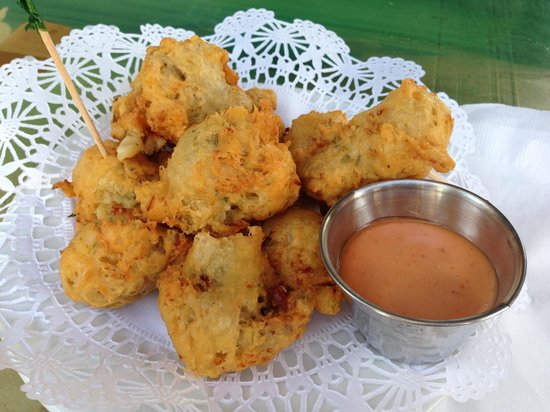
     The resulting meat is used in a wide range of foods.  It can be breaded and fried in a pan or in fritters (I purchased 4 for $1 in Freeport!), simmered in chowders or stews, steamed and served with vinegar, or soaked in lime juice and "cooked" as a cerviche, flavored with seasonings like red onion, chile peppers and cilantro.  In addition it can be made into burgers, stir fried or as a topping on salads.  It is second in popularity for snail affectionados, trailing only the escargot of France.


     Key West has adopted the conch as the official symbol of their "republic."  However, it is illegal to harvest any from U. S. waters, as they are considered an endangered species.  Consequently, any conch that is served there must come from places like the Bahamas or other Caribbean nations, such as The Turks & Caicos Islands where in November each year  an annual conch festival is observed.

     Here's a recipe for you to try the next time you have some conch meat on hand:

Conch Chowder -

Yields: 6 to 8 servings
Prep time: 30 min
Cook time: 1 hr


Ingredients:
3 onions, finely chopped
2 to 3 cloves
garlic, minced
1 green bell pepper, cored, seeded, and finely chopped
1 (14 1/2-ounce) can whole tomatoes, undrained and cut up*
2 1/2 to 3 pounds couch meat, cleaned and ground**
2 potatoes
, peeled and finely chopped
2 quarts water (approximately)
Salt and freshly-ground black pepper to taste

* To easily prepare the tomatoes, use a sharp knife and cut the tomatoes while still in the can.
** Because conch meat is very tough, you must grind it using a meat grinder or food processor.


Preparation:
In a large, heavy pot over medium-high heat, add onions, garlic, bell pepper, and tomatoes; cook until vegetables are soft.
Reduce heat to low; add ground conch meat, potatoes, and enough water to make it soupy but not watery. Let simmer 1 hour. Add salt and pepper to taste. Remove from heat and serve in individual soup bowls.
Makes 6 to 8 servings.

recipe provided by What's Cooking America


Wednesday, March 13, 2013

It's from Jamaica, Mon!

     One good way to tell the authenticity of a restaurant's cuisine is to take a look at the people who frequent the place.  It's a good sign, for example, to find tables filled with Asians enjoying their meal at a Chinese restaurant.

     On my culinary tour of Nassau I was encouraged to discover that many of the Jamaican ex-pats residing in that island nation sit down to eat at the Pepper Pot Grill.  Many native Jamaicans have come to the Bahamas in search of steady employment and have brought with them their love of jerk style of cooking. 

 
     While popularized by the people of that small British island, Jamaican jerk cooking is actually rooted in African history as slaves from West Africa were transported to Jamaica in 1655.  With them they brought recipes for preserving meat by long slow cooking using a variety of spices.  The method has been adapted and modified over hundreds of years, but the principle remains the same.  A marinade of a spicy paste is created to cover not only chicken, but also beef, pork, goat, fish and even vegetables and fruit.  It is believed that the term we use for this process, "jerk," comes from the Spanish work charqui referring to dried strips of meat.  It is the origin of our English word "jerky," for dried meat.  The word can be both a noun and a verb as "jerking" describes the way the meat is poked full of holes to allow the spice mixture to permeate while it marinates.  It is then usually baked briefly before being grilled, or smoked, over pimento wood.

     The two essential spices in the jerk rub are allspice and scotch bonnet or habenaro peppers.  Then it's pretty much empty out the spice cabinet for the remainder of the seasonings.  Various recipes include thyme, garlic, onion, sugar, salt, nutmeg, cinnamon, ginger and pimenton.  These variant ingredients are then mixed into a combination of olive oil, soy sauce, lime juice, vinegar and orange juice for the marinade.

     While I did not see the characteristic halved oil drum often used for grilling out behind the Pepper Pot, I did enjoy a flavorful meal of jerked chicken with red beans and rice and fried plantains.  And so did a lot of other patrons that day, most all Jamaicans.

Tuesday, March 12, 2013

Opa!

     As mentioned previously, there are no native Bahamians.  It is a nation of immigrants.  So it is not surprising that their food also reflects the many different nationalities who live there.  Enjoying one of the most prosperous economies in the Western Hemisphere, the islands of the Bahamas attracts people seeking a better way of life for themselves and their families.

     For centuries sponge aquaculture thrived in the cays and reefs of the Bahamas.  By the end of the 19th Century one third of the households were dependent upon sponge harvesting for their livelihood with others relying on the associated work of clipping, sorting and packing sponges for export.  Other related industries thrived as well like shipbuilding and sail making.  Many spongers immigrated to places like Nassau, coming from the lands of the Mediterranean.  And to this day there remains a significant Greek population, the descendants of those original workers desperate for work in a depressed labor market overseas.

     But unfortunately in the 1930's disease decimated the commercially valuable species of sponges and by 1939 90% had succumbed to a lethal fungus.  Greek nationals had to find other ways to earn a living.  Being the clever and resourceful people that they are, one family purchased a two story property along Bay Street in Nassau, opening a jewelry store on the first floor and a restaurant, The Athena Cafe, on the second.  Both are very successful and there is no better place on all the islands to find a genuine authentic Greek meal.  And when business peaks during the noon hour, the main meal of the day, sales personnel from the jewelry store are summoned upstairs to help wait on tables!  The food there is as open and airy as the outdoor balcony dining room.  We enjoyed a sampling of their Greek salad on a damp and windy afternoon.  Take a look at their menu from their website at www.athenacafebar.com/

http://dininginparadise.files.wordpress.com/2012/05/athena2.jpg,


Monday, March 11, 2013

Not your mama's mac & cheese

     Mac and cheese has always been a comfort food.  It's one of those meals that your mother would make, soothing with all the cheesy flavor infused among the macaroni elbow noodles.  But if your mother was raised in the Bahamas that mac & cheese would take on a different appeal with a spicy kick to it.

     Bahamian mac & cheese has a bolder profile and incorporates Bird Pepper into the mix to "kick it up a notch" as Emeril would say.  And in Nassau it's not just a polite side dish, but a stand alone meal that is sold wrapped in cellophane to be eaten sandwich style.  It's not an oozy pasta but a firm square that can stand up to any entree.  The key to making this unique Bahamian delight is to use Carnation evaporated milk and lots and lots of cheese.

     I had the opportunity to savor this spicy version of a childhood favorite at a cozy restaurant in Nassau while I was on a culinary walking tour of the town.  Bahamian Cookin' is operated by Mrs. Wallace and her hospitality was as warm as the mac & cheese.  In fact, after the tour was concluded I returned there to enjoy a healthy plate full of seafood that included plantains and their signature mac & cheese.


     Take a look at this photograph of mac & cheese Bahamian style and then, if you dare, try the recipe that follows.

http://steakinthepan.files.wordpress.com/2011/08/img_2252.jpg

Spicy Bahamian Mac & Cheese:
1 box elbow macaroni
enough water to cover noodles by about 1”
1 tsp salt
1 small onion
½ green bell pepper
1-2 small chili peppers (Thai or Bahamian Bird)
3 tsp thyme
1 tsp garlic salt
1 tsp black pepper
1 tsp paprika
½ tsp cayenne pepper
1 egg, beaten
5Tbsp butter
4 cups extra sharp cheddar, shredded
2 can evaporated milk
Directions:
Preheat oven to 400F. Grease a 9×13 pan. Place enough water in the pot to cover noodles and set on heat to boil. Meanwhile, dice onion and all peppers. Season the water with salt, thyme, ½ the paprika, garlic salt and add diced onions and peppers. Add noodles and stir occasionally to keep them from sticking. Cook on medium low heat until all of the water is gone. Turn heat to low and add butter and evaporated milk. Also add remaining paprika, cayenne (if you want it). Add cheese a little at a time, reserving about ½ cup for the topping. When cheese is melted in, continually stir as you add the beaten egg. The mixture should be relatively creamy and will set up as it bakes. Transfer to 9×13 pan, top with remaining shredded cheddar. Bake for 15-20 minutes or until golden on top and set.

Thanks to Alanna Rodgers for the recipe.
ALANNA RODGERS | Founder & PresidentTRU BAHAMIAN FOOD TOURS
alanna@trubahamianfoodtours.comP: 242 601 1725 | M: 242 477 0930
www.trubahamianfoodtours.com


Friday, March 8, 2013

Yes we have no bananas

     One of the most common foods in the Caribbean is the plantain.  It resembles a green banana and is a member of the banana family.  But that is where the resemblance ends.  While bananas are considered a fruit, plantains are regarded as a starch.  They are lower in moisture content, firmer and also have a lower sugar content.  Unlike the banana they are unsuitable to be consumed raw.  They grow in tropical areas and are often referred to as the pasta of the Caribbean.
 
     Plantains are highly nutritious, are a good source of Vitamins A & C, high in dietary fiber and an energy booster being high in carbohydrates.  They are a versatile food and can be steamed, boiled, grilled, baked or fried.  They can also be dried and ground into flour.  Some cultures use plantains as a component in banana beer, an alcoholic beverage.  We best know them as fried chips sometimes referred to as tostones or tajadas. 

     Here is a side by side comparison of bananas and plantains:

PlantainsBananas
  • Starchy
  • Used as a vegetable
  • Longer than bananas
  • Thicker skin
  • Resemble green bananas, but may be green, yellow or black
  • Sweet
  • Eaten as a fruit
  • Shorter than plantains
  • Thinner skin
  • Color is green when not fully ripe, yellow when ripe


Thursday, March 7, 2013

Chillin' Out

     It's always nice to chill out a bit in the dreary mid-winter months.  I went with a culinary companion in search of new food vistas where it is supposed to be warm and sunny.  I say supposed because our trip to the Republic of the Bahamas was anything but that.  While all the travel information would have you believe the February/March average high is near 80 degrees we had the distinction of being there for the coldest weather of the year with an extraordinary low of 43 degrees and a damp and windy high barely in the 60's.


     But all was not lost and I did enjoy one amazing walking cultural and culinary tour of Nassau, the country's capital.  In 3 hours Alanna Rodgers, the tour's founder and guide (Tru Bahamian Food Tours) provided us with an incredible wealth of information.  Not only did she take us to 7 different culinary venues, but also outlined the history, culture, and social mores of the island nation.

     I learned more in those 3 hours than I could have researched in 3 weeks of independent study.  Did you know that there are over 700 islands that cover 180,000 square miles of ocean space stretching from the southeast coast of Florida to the northwest coast of Hispaniola?  And the GDP of the Bahamas ranks 3rd in the Western Hemisphere, behind only the US and Canada.  The literacy rate is an impressive 98%.

     But back to the food...It's not only about the conch, a popular ingredient in things like salads, fritters and chowder.  There is so much more that the many ethnic groups brought with them as they settled there.  Oh, and by the way, the Republic of the Bahamas is one of the few nations on earth that is populated entirely by immigrants.  The native Arawak Indians, known as the Lucayans, were totally annihilated by disease after the Europeans arrived following Christopher Columbus' "discovery" of what he called San Salvador.

     So, chilly weather aside, I am eager to share with you in the next several reports some of the things that make the Bahamas unique.  And if I ever need to find employment there I could always work at this place, provided I can multi-task: