Wednesday, October 28, 2015

The Lone Star State

     Once again in the name of culinary research I will be traveling to investigate yet another regional cuisine.  This time I will be hard at work in a state that was once a sovereign nation. Deep in the heart of Texas I will be attending a very special BBQ event in the capitol, Austin. Stay tuned for a full report when I return!!!


Tuesday, October 27, 2015

Too Much Love

Philadelphia has many iconic images.  Two of the more familiar ones are the statue in Love Park:


And the cheesesteak.
 

People living in the Delaware Valley love a good cheesesteak, wit or wit out the gooey Cheese Whiz slathered on the grilled paper thin rib eye.  In fact, there are many derivations of the classic, each vying for acclaim.  So why not hold a festival and give everyone an opportunity to decide which one is their favorite?
 

That's exactly what occurred last Saturday at the 1st ever Cheesesteak Festival held in the tailgaters' parking lot of Lincoln Financial Field in the South Philly Sports Complex.  58 vendors set up shop, rolling in with food trucks and portable grills to cook up their version of the classic sandwich.   Porkroll, brisket, jerk, Reuben, Greek feta, mac & cheese...you name it, they were all there.  Even things like cheesesteak egg rolls, pierogies, pretzels, nachos and quesadillas were there to sample.


It was an overwhelming success.  Perhaps a little too overwhelming.  25,000 tickets were sold on-line in advance.  The event was sold out.  And everyone showed up.  Parking at $20 a car was a nightmare.  It took some folks over an hour just to get into the lot, putting them behind all the other thousands who waited patiently to show their $20 admission ticket and get in the gate at 11am.  But that wait seemed tolerable in comparison to standing in long lines waiting to exchange a $2 food voucher ticket for a small bite of cheesesteak sample. 


 Those lines snaked for over 2 hours in some cases.  People who came enthused ended up leaving disgusted and disappointed.  One person was kind with his on-line comment, "...it was a great idea poorly executed."


It was just too much love all in one place.


Monday, October 26, 2015

Suitable for Framing

This is the take-out box from an Italian restaurant just outside Florence.  It's a work of art!  The words just above Mt. Vesuvius reads: Hot & Good."


Friday, October 23, 2015

Any Way You Slice It

     As you might suspect pizza is a very popular item in Italy.  It's on almost every menu, from the casual eatery to the fine dining establishments.  On one occasion I counted 46 different kinds of pizzas being offered at a single restaurant!


     Pizza probably got its start as a step up from the common focaccia, or flat bread that was baked in an oven.  There are documented accounts of the word appearing as far back as 997AD in Gaeta, Italy.  And remains of Italian flat bread has been calculated to be over 7,000 years old.

     But the pizza as we know it is a more recent invention.  In the late 18th Century the poor residing around Naples began to add tomatoes to their yeast baked bread and hearing of this new creation visitors began to arrive to give it a taste.  And that's when different toppings began to proliferate in an attempt to please diverse palates.  But to the purist there are really only 2 styles of pizza:  Marinara and Margherita.

     The older of the two, Marinara, is very basic, having only tomato, olive oil, garlic and oregano topping the flat bread.  The name is derived from the wives (la marinara) of sea farers who would bake the pizzas upon their husband's return to the Bay of Naples from the open sea.


     Margherita pizzas use a more modest amount of tomato topped with mozzarella cheese and fresh basil.  It is said that Raffaele Esposito baked one for the Queen Margherita of  Savoy in 1880.  She liked it because it reminded her of the tri-color flag of the fledgling nation with its red, white and green panels.


There are also some regional variants to pizza style, too.  Those baked around Naples tend to be soft and pliable, while those in Rome are thin and crispy.  Pizza al taglio is baked in rectangular trays and is sold by weight.

Thursday, October 22, 2015

Suspicion confirmed

     I was immediately suspicious when the formally clad waiter in the fancy ristorante with the white linen tablecloths wasn't writing down each order for our table of 6.  So it was no surprise when he brought to my place something I hadn't ordered, nor did I want.  I had chosen for my evening meal Risotto di Mare, a creamy northern Italian dish composed of shellfish and Arborio rice.

     Risotto is a labor intensive dish requiring substantial time to prepare.  I knew that and was willing to wait for the chef in the kitchen to properly cook the short grain rice so it could slowly absorb simmering hot broth as it is added one half cup at a time, releasing the starch in the rice.  That is what creates the smooth creamy-textured base for the clams, mussels, and shrimp.

     Risotto is significantly different from just plain rice in a number of ways.  First, it matters what kind of rice is used.  Only Arborio, Cornaroli or Vialone Nano are used in Italy.  The short grained rice is cooked briefly in a soffritto of onion and butter to coat each grain in a film of fat before a splash of white wine is added and allowed to evaporate.  Then the rice is slowly flavored with broth that has been heated till is is just below the boiling point, made from either vegetables, meat, poultry, seafood or legumes.  Stirring constantly the broth releases the starch as it is absorbed.  Only after about 20 minutes is the risotto ready to receive the final touch with the addition of cold butter and grated Parmesan-Reggiano cheese, before the seafood greets the plate.

     So when the waiter reluctantly took back the plate of rigatoni and meat sauce and quickly returned with something resembling my order, I knew that it was not authentic risotto but an impostor disguised to look like the real thing.  You be the judge:


Wednesday, October 21, 2015

Twice Baked, Once

     Biscotti is a traditional Italian almond biscuit.  Credit for its creation is given to 19th Century pastry chef Antonio Mattei in Prato.  His recipe used only flour, sugar, eggs and almonds to make the dry, crunchy oblong cookie.  His secret was to bake the dough twice, first as a long log and then a second time after the log had been cut into inch thick strips.  

     Biscotti means just that, twice baked and the advantage of doing so was to create a biscuit that could be stored for a long time.  To soften it a bit before eating the biscotti are usually dunked in a drink, like Vin Santo.

     However, our host and chef extraordinaire, Fonzie, recommends baking the dough only once, since they don't sit around very long before being eaten.  Here is her recipe:


Biscotti with Almonds
 

Ingredients

3 cups of unsalted whole almonds, roasted in a frying pan
4 1/2 cups of "0" flour
3 1/3 cups of sugar
pinch of salt
7 eggs
orange zest
1/2 packet of yeast
4 tsp of baking powder
10 Tbsp of melted butter

Directions

On a large flat surface create a circle with the flour with a well in the middle.  Add the sugar to the well, then add the eggs.  Scoop up the flour around the mixture to hold the eggs.  Whip the eggs in the middle of the flour then add the orange zest and the melted butter.  Mix the remaining dry ingredients into the egg mixture a little at a time until fully incorporated.

Add 1/2 of the roasted almonds to the mixture.  Add more flour if dough seems sticky to make a better consistency.  Add the rest of the almonds and fold in repeatedly.  Place mixture in a large bowl to rest in the refrigerator until chilled.

Roll out the dough into long rolls approximately 1 1/2 feet long by 1 1/2 inches in diameter and lay on a parchment paper lined cookie sheet.  Brush water or egg wash onto the rolls and sprinkle with sugar to taste.

Place in oven on both shelves at 350F for 30 minutes.  DO NOT bake twice!

Cut into pieces immediately out of the oven.

Recipe courtesy of Alfonsina Ricchi, Il Praeto, San Donato, Italy

Tuesday, October 20, 2015

English Soup

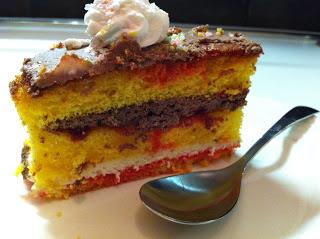
     Having a similarity to Tiramisu, Zuppa Inglese is another wonderful Italian dessert.   The name can be misleading, it is not  English Soup as the literal translation from Italian might suggest but rather a layered dessert incorporating custard, sponge cake and chocolate into something quite similar to an English trifle.


     The confusion with the name seems to lie with the use of the word zuppa, thought by some to be a shortened version of  inzuppore meaning "to dunk or sop."  Of Tuscan origin dating back to the 17th Century it continues to be a homemade dessert with sponge cake being dipped in Alchermes, an aromatic Italian herb liqueur and layered with custard.  Over the years the substitution of rum or Chambourd has been made.  The chilled layered dessert is often topped with chocolate and/or bordered with piped vanilla cream.


     Our group was treated to Fonzie's version of this sweet creation during our stay at Il Faeto in San Donato.