Tuesday, October 13, 2015

Don't worry...it's only pasta!

     Our chef/instructor Alain repeated those words of encouragement throughout our cooking class in Tuscany as we attempted to make pasta, many of us for the first time.  "Don't worry, it's only pasta!"


     The task seemed simple enough.  After all, there were only two ingredients: flour and eggs.  What could go wrong?  Take 3/4 of a cup of 00 flour and break an egg into a well that you have made in the center of the flour.  Slowly incorporate the flour into the egg using a fork horizontally, not vertically, until you have a consistent mixture of the two.  Then work it with your hands, folding and gently pressing.  But not too much!  Overworking it will lead to tough, chewy pasta and you don't want that.  Roll it into a ball and then tightly cover it in plastic wrap for about 20 minutes.  When the time is up unwrap it and work it gently with the palms of your hands and then roll it out with a rolling pin into a thin sheet.


     Sounds easy, doesn't it?  Well, not everyone achieved success on the first try.  But eventually the class was able to use their pasta to form ravioli and tagliatelle.  


     Our reward was to enjoy the fruits of our labor as we sat together around a large wooden table to a feast we had created!


Monday, October 12, 2015

Trans-Continental Delight

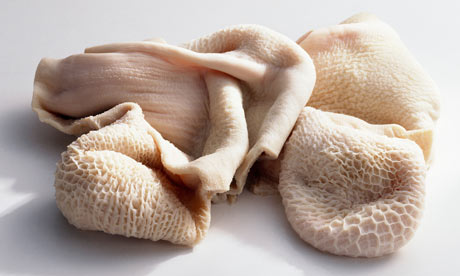
     Tripe is enjoyed throughout Italy in dishes such as Trippa alla Fiorentina and Trippa alla Romana.  And while the supporting cast in those recipes can vary somewhat, the starring role belongs to the lining of the stomach of a ruminant.  Most often it is that of a cow but can also be from a pig, sheep or ox.


     Preparation of the tripe is key.  It needs to be washed thoroughly and boiled for several hours before it is sliced into strips and cooked with tomatoes, vegetables and white wine. Those who have tried it claim that it is full of flavor with a decidedly mineral taste coming from a high phosphorus and calcium content.  It is also high in cholesterol, however.

     But did you know that tripe also has a very local connection?  In addition to scrapple, hoagies and soft pretzels Philadelphia is also known for its Pepper Pot Soup made from tripe.  Legend has it that the thick peppery stew was first concocted by Baker General Christopher Ludwig of Washington's Continental Army.  During the harsh winter of 1777-78 during the encampment at Valley Forge it was Ludwig who devised the recipe to feed the troops.  It was either that or starvation.


     I think I'd need to be pretty hungry, too, before I would consider a spoonful.

Friday, October 9, 2015

Learning from a Pro

     
     While on my culinary sojourn through Italy I spent a day under the tutelage of Alain, a professional chef and our guide.  He was a member of the Food & Wine Academy of Florence.  I met him one morning in the shadow of the Duomo that towers over the city and he led our group through town to the Sant' Ambrogio Market.  It has both indoor and outdoor vendors and Alain claims it is the most authentic of the markets in the city, better than the famed Central Market that he says is just for show and more of a tourist destination than a place to purchase fresh ingredients.  And if you get there early you will see many of the top chefs and restaurateurs there shopping to supply their kitchens.


       We made our way around the outdoor vendors and sampled some of the fruits and vegetables, including something called a Tabaccheria Peach.  It was a squatty looking fruit, akin to our doughnut peach, thin skinned with a white flesh and a very juicy interior.  The name in Italian translates "snuffbox" because it has that shape if you use your imagination.  It does not travel well and is consumed locally, close to where it is grown, and it has a very short season.  It is so juicy in fact, that it is recommended that you eat it over the sink!


     Going inside we were introduced to no less than 24 regional salumi, ranging from Tuscany to Milan and everywhere else in between.  And of course there were so many shanks of prosciutto hanging that I lost count.  I also came across a cooler case of coniglio.  And although I was unfamiliar with the Italian name I did recognize the shape as rabbit.  Another popular item was tripe, cow's stomach.  I think it is what we would call an acquired taste!


Thursday, October 8, 2015

Hey! It's Italian!

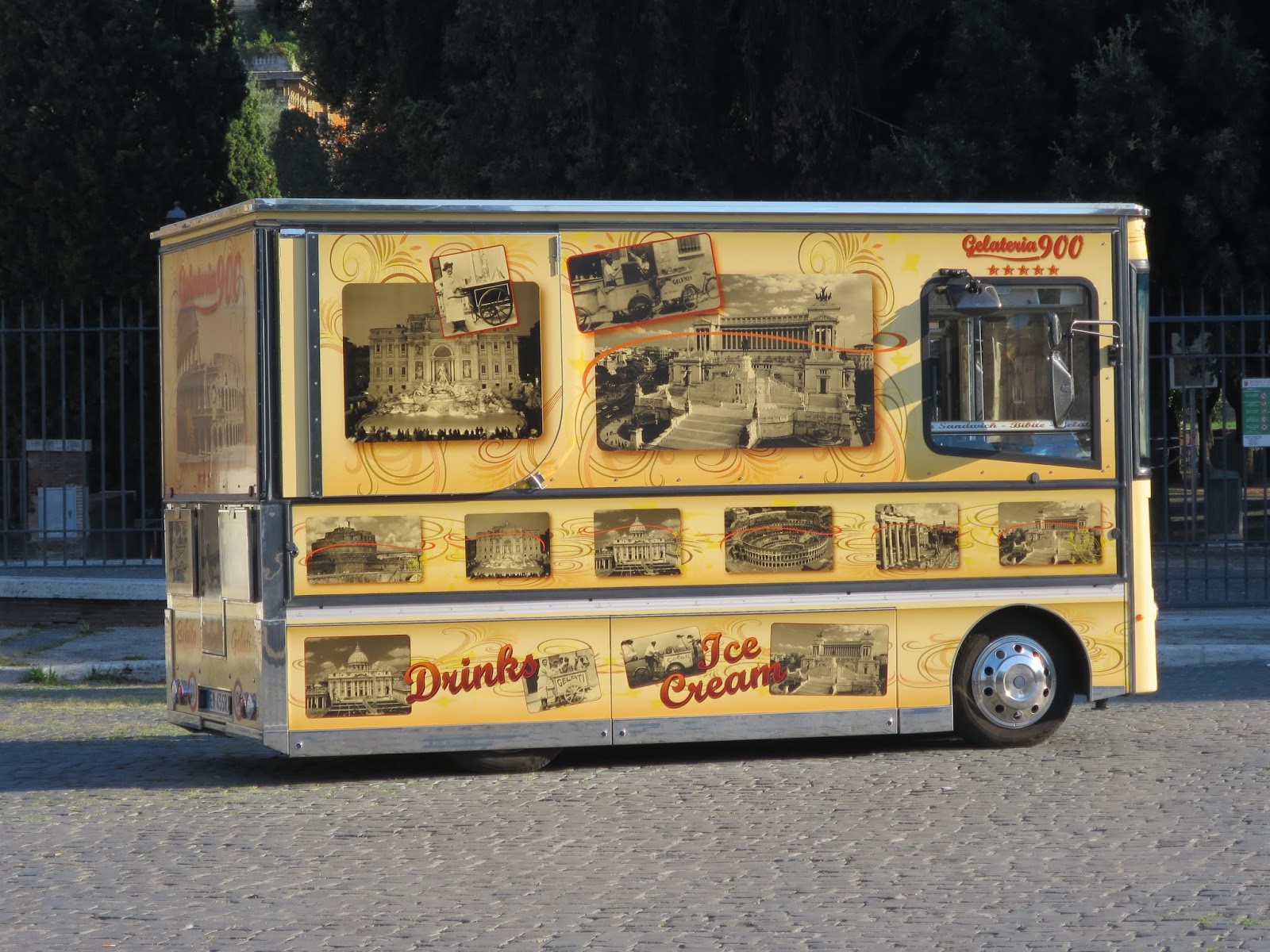
     Italian cuisine is among the best in the world.  I can say that having sampled more than my share of wonderful meals on my sojourn there in September.  But the one thing that I enjoyed almost every day was a generous helping of gelato, and in a variety of flavors.


     And while it might look like our American ice cream, it is distinctly different.  To add to the confusion between the two the word gelato is Italian for ice cream.


     Real Italian gelato is churned at a slower rate incorporating less air into the mixture.  Typical American ice cream consists of at least 25% air  (called overrun in the business). But gelato is more dense with less air in it, creating a more intense flavor.


     Both ice cream and gelato contain cream, milk and sugar, but in different proportions.  Gelato has more milk and less cream.  Our ice cream contains from 14 to 25% butterfat, gelato's number is only 4 to 9%. That translates into less coating of the taste receptors on the tongue so that the true flavor can shine through.  And gelato contains no egg yolks that are common in ice cream recipes.


     Another significant difference is in the serving temperature.  Gelato is served 10-15 degrees warmer, giving it a silkier and softer texture.  And being warmer is tends not to numb the mouth the way ice cream does, again enhancing the flavor profile.


     So consider gelato to be a healthy alternative to ice cream and treat yourself to a generous serving of Italy's most famous dessert!


Wednesday, October 7, 2015

Field of Flowers

     Until about 1400 years ago Campo de' Fiori was just that, a field of flowers.  Once a vegetable and flower garden it is now one of Rome's most famous open air markets, just a short walk from my apartment overlooking the Piazza Navona.


     So on one morning in a soft rain I made the early morning trip to check it out.  Open every day except Sunday it is a plethora of color with stalls bursting with fresh fruits and vegetables, spices, oils,  pasta and of course, flowers!


     But amid all the vendors there stands a reminder of a dark past.  Overlooking the square is a statue of Dominican Friar Bruno Giordano.  Philosopher, mathematician and astronomer, he was burnt alive on the square in 1600 for heresy.  His crime?  Advocating the Copernican theory that the sun, not the earth, was the center of the solar system.  The square in addition to being the location for public executions was also at one time a horse market twice a week on Mondays and Saturdays.


     Surrounding the market area are many small shops and markets.  At one end is La Terrina,  the fountain known to locals as "The Fishbowl."  And at the other end is the historic Taverna della Vacca, literally The Cow's Inn.


     By mid afternoon the vendors have gone and the square changes complexion, becoming a place for impromptu soccer matches. But by nightfall it is a notorious night spot frequented by drunken tourists and local rabble.

Tuesday, October 6, 2015

Seriously

     Italians are serious about their food.  Whether prepared at home or served at a dining establishment meals are savored and celebrated.  So it stands to reason that they are very particular with their terminology.  While in America we go to a restaurant, Italians have a more precise way to identify such places.  Here is the way they accomplish that:

Osteria-Originally a place serving serving a simple meal at shared tables, often frequented by a male dominated clientele.  The oldest known osteria was established on Bologna in 1375.  Following that tradition, today you can get pasta and grilled meats and fish without having to refer to a written menu.


Trattoria-Modest but plentiful food is provided in a casual and informal setting.  It is usually a family run operation with Nonna in the kitchen preparing regional and local fare like ribollita, carbonara or pesto.  The children wait tables at the family style service and Dad works the till.


Ristorante-More formal with table linen and a professional wait staff.  This upscale kind of place is where you will find professional types and tourists perusing the extensive menu.


In addition there are also places known as:

Taverna-similar to our American tavern, a place for a drink and a snack, usually with a rustic ambiance.


Enoteca-In addition to serving wine, the enoteca can provide a variety of panini sandwiches and light nibbles like olives and cheese.


Tavola Calda-Literally "hot table" it is the Italian equivalent to a quick service cafeteria providing a meal for those to prefer "take-away" or what we would call carry-out.


And on almost every block there are two very familiar establishments, the Pizzeria and the Gelateria.  But more on them later...

Monday, October 5, 2015

Ciao!

     While my computer was being serviced and updated I spent some time in culinary research.  Since my favorite cuisine in the world is that of Tuscany I decided to learn first hand about its history and culture.  And while in Italy I also delighted in some of the other regions, just to compare recipes.


     Cucina Italiana is not a singular flavor but rather a palate of cooking tastes and styles.  And while Italy is known for its simplicity, emphasizing quality over quantity, there are 20 different regions within the country that did not nationalize until the 19th Century.  Fresh, seasonal and local are the benchmarks of Italian cuisine throughout the nation.  Using few ingredients and straightforward cooking methods chefs create food full of flavor sourced from the fish of the sea that surrounds them, meat, both freshly butchered and cured, from the farm, and vegetables from the garden.  Over their long history Italians have mastered the use of olive oil, cheese and tomatoes to accent and highlight each meal.  And with over 350 shapes of pasta, dried and fresh, it's no wonder that the average Italian consumes 62 pounds of it a year!


     My education began as I became accustomed to the meal schedule.  Colazione is breakfast and is unlike the American counterpart.  It is usually very light and is most commonly just cafe latte and pastry.


     Pranzo is eaten around 1pm and is traditionally the heartiest meal of the day.  It is not hurried but enjoyed in no less than 4 courses: Antipasti (literally "before pasta"), Primi (first course), Secundo (main course) that can include Contorno (side dishes), and Dolce (dessert).


     Cena is equivalent to our evening meal and is a lighter version of Pranzo, typically not begun until after 7pm in most households.  It could include unused portions of lunch.

     In the next few days join me as I recount my journey.  Buon Giorno!